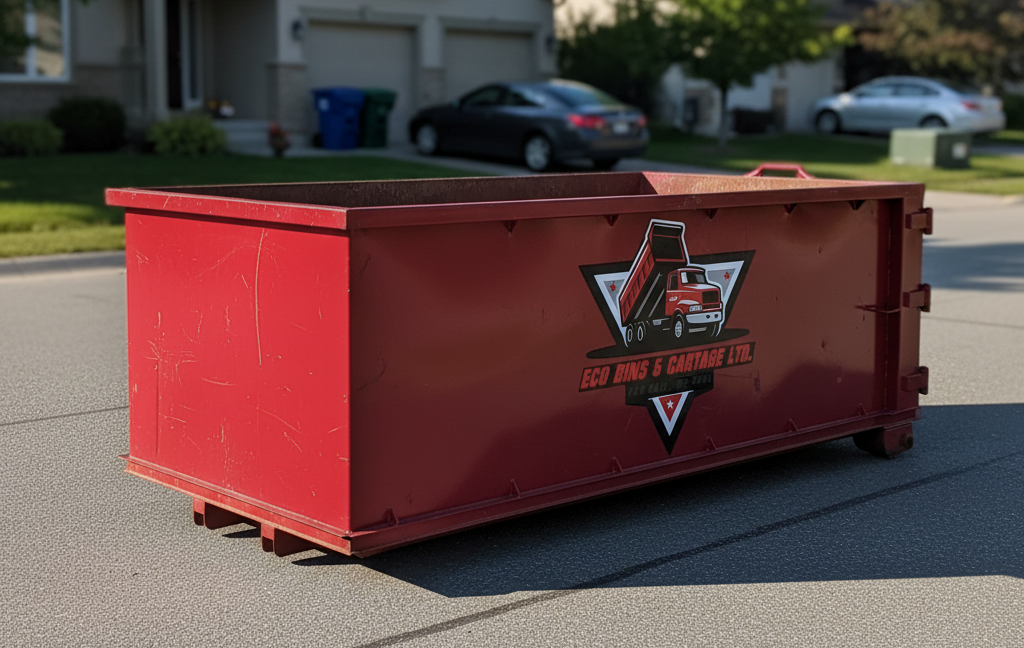
“Can you put the bin in my driveway?”
In summer, that’s a simple yes. In January? It depends on about six factors you probably haven’t considered.
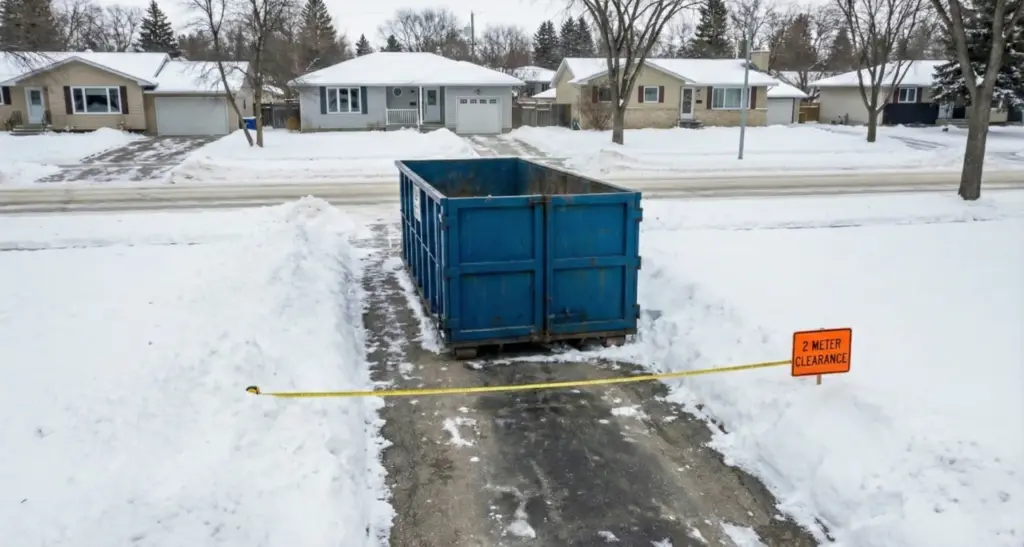
Winter bin placement isn’t just “find space and drop it there.” Snowbanks consume 1-1.5 meters on each side of driveways. Frozen ground affects bin stability. City snow clearing regulations restrict where bins can sit. Access for pickup changes daily as snow conditions shift.
Get placement wrong and you face bins you can’t load, can’t get picked up, or (worst case) violate city bylaws and get fined. Understanding what works and what doesn’t makes winter projects significantly easier.
Driveway vs Street Placement
Your Driveway (Usually Best Option)
Your driveway is private property. You control snow clearing. Bin placement here works when:
- Snow is already cleared: You need 3-4 meters of width for bin plus vehicle access. Most driveways provide this in summer. In winter, measure between snowbanks.
- Surface is stable: Frozen asphalt or concrete supports bins without issue. Unpaved driveways or areas with snow pack create stability questions.
- Pickup truck can access: Our trucks need straight-line approach to bins within about 10-15 meters.
- No overhead obstacles: Power lines, tree branches, eaves—bins need crane clearance for pickup.
Street Placement (More Complicated)
Placing bins on residential streets works sometimes. But City of Winnipeg parking regulations apply:
- Snow route restrictions: During winter months (typically December 1 to March 1), designated snow routes prohibit parking, including bin placement, during snow clearing operations.
- 24-hour rule: Even on non-snow-routes, bins can’t occupy street parking longer than 24 hours during active snow clearing periods.
- Windrow considerations: City plows create windrows (those compacted snow barriers) at driveway entrances. Bins placed on streets often end up partially buried.
Check City of Winnipeg’s website for current snow route maps and parking restrictions before committing to street placement. Fines for violating snow clearing regulations run $100-200.
The Snowbank Problem
Here’s what happens: you clear your driveway in November. Bin gets delivered. Works fine for a week. Then we get 30 cm of snow. You clear again, piling snow on both sides. Now your 4-meter driveway is 2.5 meters wide between snowbanks. And the bin sits right where you need to pile snow.
This creates a few scenarios:
- Best case: Bin is positioned where snow can be piled around it without blocking access
- Common case: Bin ends up partially blocked by snow accumulation
- Worst case: Bin gets completely buried or inaccessible behind snowbanks
- Position bins 1-1.5 meters from your typical snow pile locations
- If your driveway narrows significantly with snow, consider front yard placement on firm, level ground
- Mark bin location with stakes or flags
- Coordinate delivery timing—if major snow is forecast, plan accordingly
Frozen Ground and Bin Stability
Bins on frozen ground are actually quite stable—frozen soil provides firm support. But there are situations where frozen ground creates problems:
- Thawing periods: Mid-winter warm spells soften ground that was frozen solid days earlier. Heavy bins can sink into softened ground.
- Snow-covered lawns: You don’t know what’s under 30-40 cm of snow—could be firm ground, could be soft soil, could be a flowerbed.
- Spring pickup: Bins delivered in January on frozen ground might sit until March for pickup. Ground conditions change dramatically over two months.
Protective measures: For longer-term placements or questionable ground, we can place boards or timbers under bins distributing weight over larger surface area.
City Plow Windrows (The Surprise Factor)
You planned everything perfectly. Bin is in your driveway, 2 meters from the street entrance. Then we get 15 cm overnight. City plows come through. Now there’s a 1-meter-high windrow of compacted snow across your driveway entrance, right where the bin is.
This is surprisingly common. City plows push snow to right side of streets (from driver’s perspective), which means directly across residential driveway entrances.
Timing considerations:
- Residential streets typically get plowed 2-3 days after major snow (City of Winnipeg priority system handles main routes first)
- If bins need pickup during this window, you’re clearing windrows as part of the process
- If your project timeline is tight and snow is forecast, front yard placement (away from street entrance) eliminates windrow problems entirely
When to Call Ahead
Some situations require discussion before delivery:
- Narrow access: Driveways less than 3 meters wide (summer measurement) need assessment for winter feasibility. We might need Moffett delivery for precise placement in tight spaces.
- Questionable surfaces: Unpaved driveways, areas with uncertain base support, locations where snow cover hides surface conditions.
- Long-term placement: Bins staying on-site more than 2-3 weeks span significant weather variation.
- Complex snow clearing situations: Properties with limited snow storage, HOA restrictions, or unusual drainage/access patterns.
- Uncertain city regulations: If you’re unsure whether your street is a snow route, ask before assuming street placement works.
EcoBins & Cartage handles winter placements throughout Winnipeg. We’ve seen every combination of snow, access, and timing challenges. When in doubt, describing your specific situation lets us advise on what works.
Practical Winter Placement Checklist
Before Delivery
- Measure clear width between snowbanks (not summer driveway width). Need minimum 3 meters.
- Check overhead clearance—power lines, ice-loaded branches, eaves with snow buildup.
- Verify no snow routes or parking restrictions affect your planned placement.
- Clear intended placement area to ground level if possible.
- Mark any hidden obstacles under snow.
During Bin Use
- Maintain clear access path from driveway/street to bin.
- Watch for ground softening during warm periods.
- Keep bin accessible for pickup.
- Don’t pile snow directly against bin sides if you can avoid it.
For Pickup
- Clear any new snow accumulation from around bin before scheduled pickup.
- Remove any ice buildup that might prevent bin movement.
- Ensure approach path from street to bin is clear.
- If ground conditions have changed significantly since delivery, notify us.
Winter-Specific Positioning Tips
- Avoid the lowest point on your property—meltwater collects there
- Position for sun exposure when possible—south-facing locations experience more melting
- Consider prevailing wind direction—drifting snow accumulates on leeward sides
- Leave extra space—what seems adequate in November might be tight in January
- Communicate changes—if situation changes between booking and delivery, call us
Making Winter Placement Work
Winter bin placement requires more thought than summer placement. But it’s completely workable with planning and realistic expectations.
We deliver bins year-round in all conditions. Our Moffett delivery capability handles tight winter access that defeats standard trucks. Experience with Winnipeg winters means we’ve solved access problems you haven’t encountered yet.
Projects involving winter landscaping work with Lawn ‘N’ Order or material delivery from Ditchfield Soils often need coordinated bin service.
Contact EcoBins Call: (431) 317-8581Winter placement isn’t harder than summer—it’s just different. Snow accumulation, frozen ground, and city regulations replace summer’s concerns about lawn damage and aesthetic impact. Understanding these winter-specific factors makes the difference between smooth service and unnecessary complications.
Related Resources
- EcoBins & Cartage Winter Service
- City of Winnipeg Snow Route Maps
- Winter Bin Rental Planning Guide
- Lawn ‘N’ Order Winter Services
Successful winter bin placement comes down to understanding access requirements, city regulations, and how snow changes your property’s usable space. Plan accordingly and adjust as conditions change.