
Concrete Disposal Winnipeg: Weight Limits & Recycling
- Clean concrete and brick are not garbage: in Winnipeg, both can be recycled into aggregate through local facilities including Rakowski Recycling and Paragon Industries
- Concrete is the heaviest material Ecobins bins commonly receive: a single cubic yard of concrete weighs approximately 2,000 to 2,400 lbs, compared to roughly 400 lbs for mixed renovation debris
- Tipping fees apply at $99 per metric tonne based on actual load weight; a bin even partially loaded with concrete will generate tipping fees that exceed the base rental cost
- Ecobins & Cartage can accommodate concrete and brick loads when booked with that context: mention heavy material when booking so the right bin, truck, and disposal routing are arranged
- Mixed loads of concrete and regular renovation debris are accepted but complicate recycling: clean-separated concrete loads are more likely to be routed to a recycler rather than a landfill
Concrete and Brick Are Recyclable, But Most People Don’t Know Where
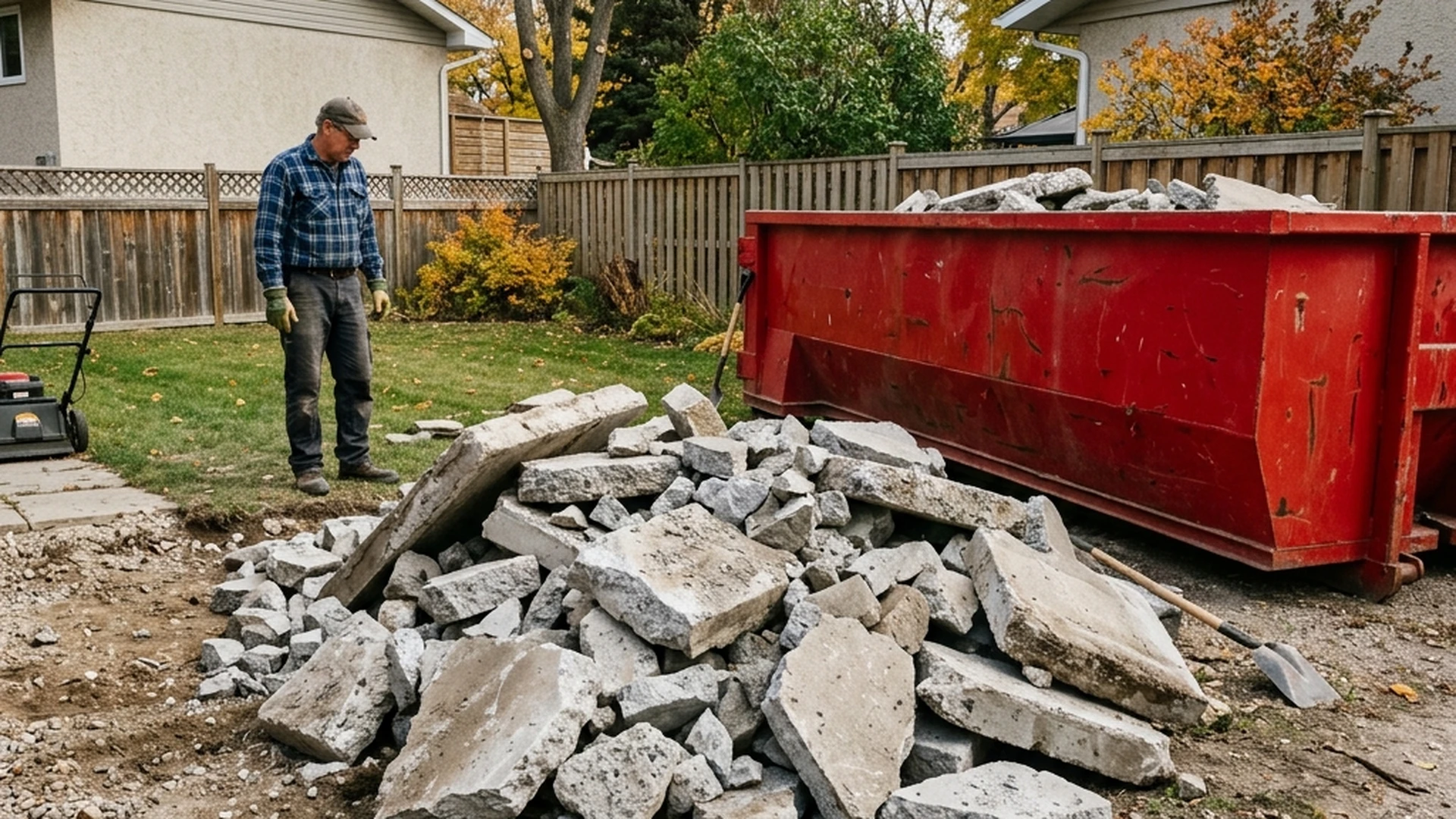
When a homeowner demolishes a concrete patio, breaks up an old driveway, or tears out a brick planter, the instinct is to call it garbage. In Winnipeg, it is not. Clean concrete and clean brick are materials that local processors can crush and convert into aggregate for road base, driveway sub-base, and fill applications.
This matters for two reasons. First, it is better for the environment: diverting material from the Brady Road landfill and converting it into reusable aggregate is a meaningful outcome for what is otherwise a bulky, heavy waste stream. Second, it matters for your wallet: facilities that accept clean concrete may take it at no charge or minimal cost, while the same material in a general waste bin generates tipping fees by weight.
Where Clean Concrete and Brick Go in Winnipeg
Rakowski Recycling, 1229 Redonda St
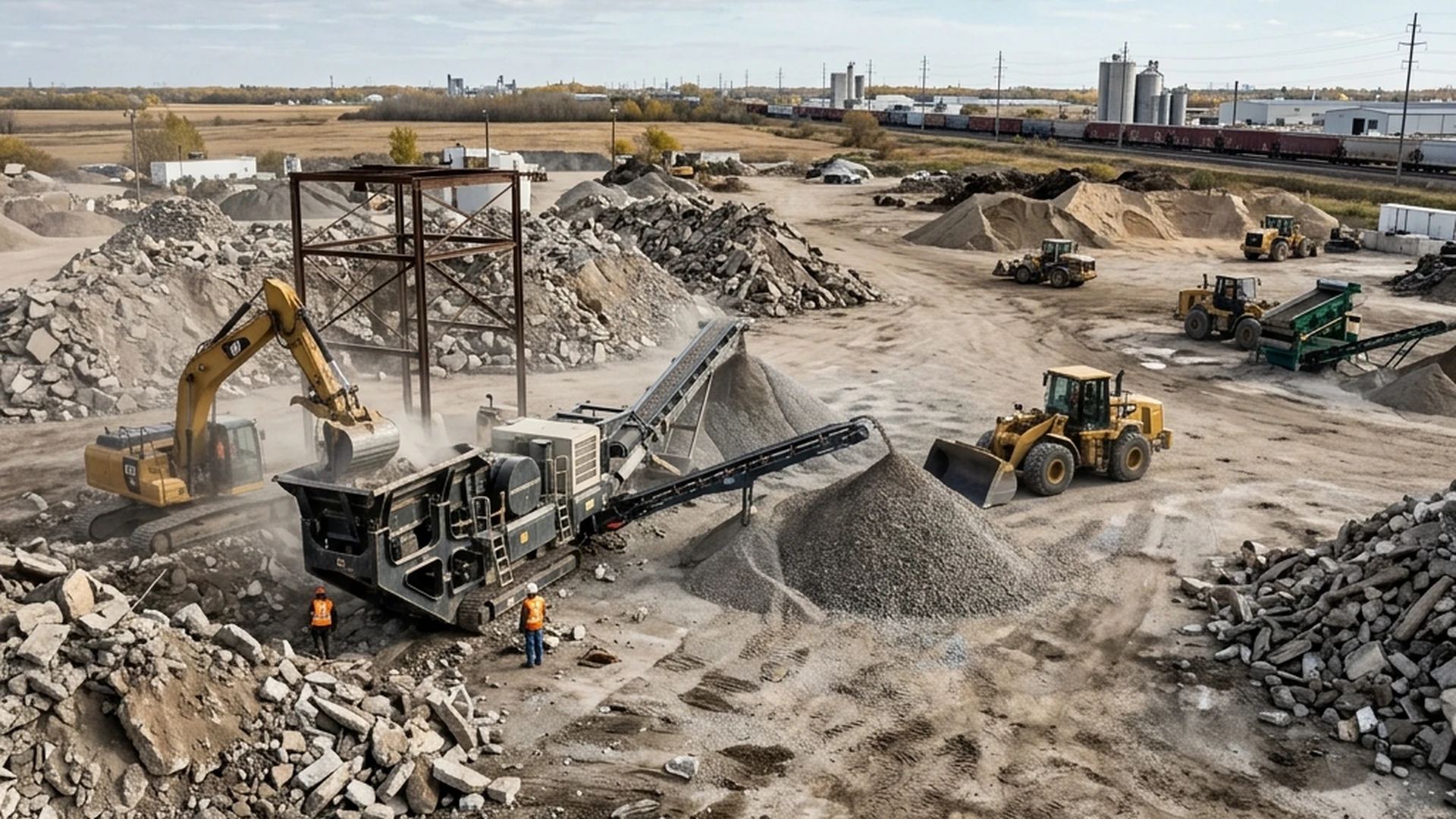
Rakowski Recycling operates a concrete recycling yard at 1229 Redonda St in Winnipeg. They have accepted and processed concrete rubble into reusable aggregates for nearly two decades. Clean concrete, material free of excessive garbage, mud, organic material, and rebar, is accepted at no charge. Concrete with rebar is not processed at Rakowski. Oversized pieces (larger than 24 inches square) or loads requiring assistance to unload may incur additional fees. No appointment is required for drop-off. Processed recycled concrete goes into road and parking lot base construction, becoming aggregate that displaces the need for newly quarried stone.
Paragon Industries
Paragon Industries Ltd., operating since 1965, handles concrete, asphalt, and steel in their recycling and material salvage division. Unlike Rakowski, Paragon accepts concrete with or without rebar, which makes them the right call for foundation or slab work where rebar is embedded. They serve both residential and commercial-scale material. Their Salvage Supermarket division also accepts and resells reusable building materials, which may be relevant if brick removal includes materials in reusable condition.
When Material Is Not Clean Enough to Recycle
Recyclers are specific about contamination. Concrete mixed with significant quantities of soil, organic material, rebar longer than 2 feet, wood, or other debris may be rejected at recycling facilities or accepted with additional fees for processing. Material that cannot be separated will go to the Brady Road Resource Management Facility as general C&D waste.
The practical guidance: if the concrete or brick is genuinely clean, separate it from other renovation debris and either self-haul to a recycler or flag it to Ecobins & Cartage when booking. If it is mixed with other demolition material, a general bin handles the load and the material goes to the appropriate disposal facility.
How Ecobins & Cartage Handles Heavy Material
Weight Limits and Why They Matter
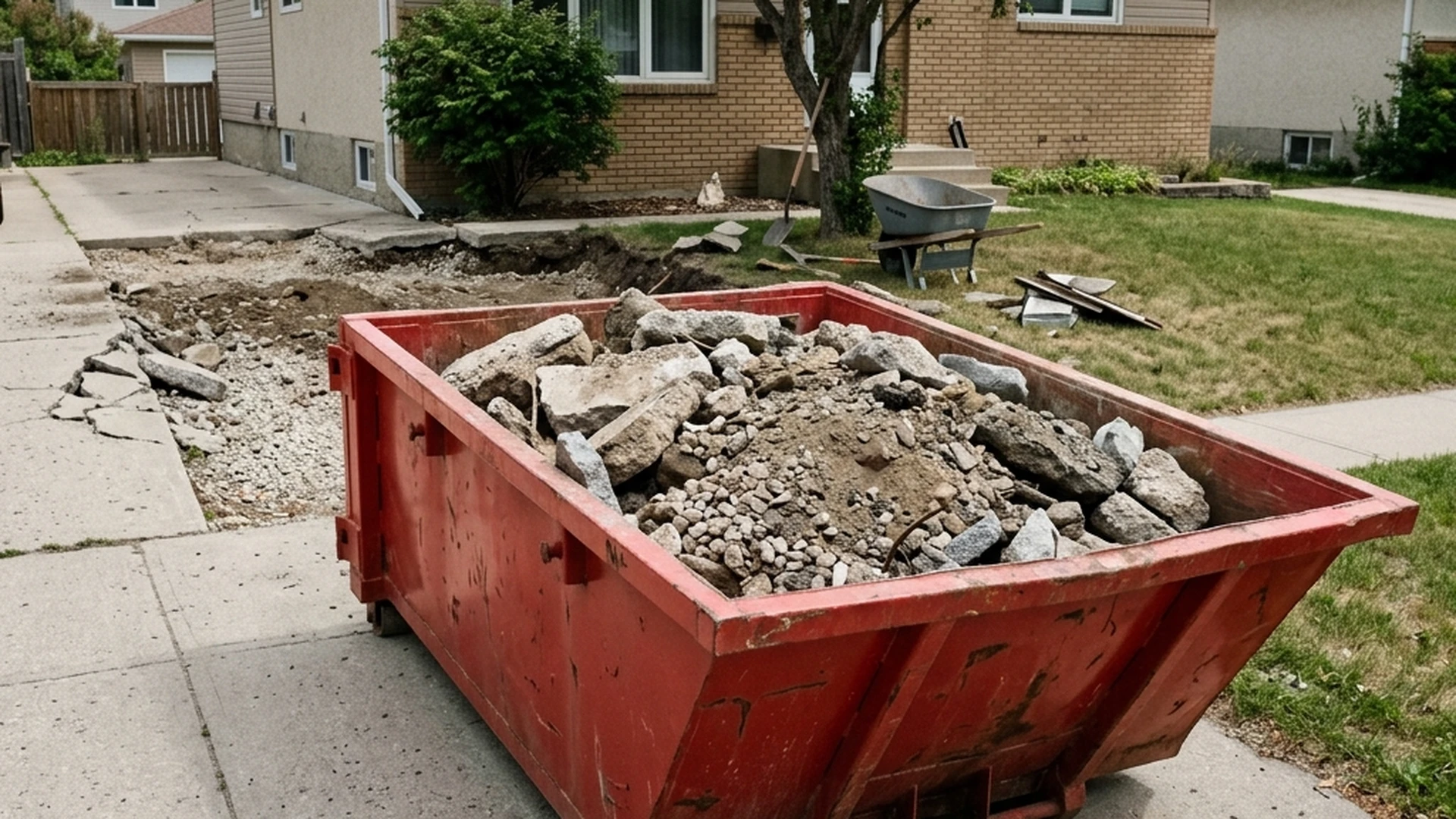
A standard Ecobins & Cartage bin is designed for mixed renovation and cleanout waste. The challenge with concrete and brick is not volume, a relatively small pile of concrete occupies less space than it weighs. A single cubic yard of concrete weighs approximately 2,000 to 2,400 lbs. A 20-yard bin loaded exclusively with concrete would theoretically reach 40,000 to 48,000 lbs, well beyond what a bin truck can legally carry on Winnipeg roads.
In practice, most concrete disposal projects generate mixed loads rather than full bins of pure concrete. A driveway removal includes some soil and gravel with the concrete. A patio demo includes some sand base material. The weight per cubic yard is high but the load is usually mixed. The tipping fee structure, which is based on actual weight at the scale, captures this accurately.
Tipping Fees on Concrete Loads
Tipping fees are charged at $99 per metric tonne based on actual load weight recorded at the disposal facility scale. A load that is even 30 to 40 percent concrete by volume will generate significantly higher tipping fees than a load of equivalent volume in mixed light renovation debris.
| Load Content | Approx. Weight per Cubic Yard | Tipping Fee per Cubic Yard (approx.) |
|---|---|---|
| Mixed renovation debris (drywall, wood, light materials) | 200 to 400 lbs (0.09 to 0.18 tonnes) | $9 to $18 |
| Mixed C&D with significant concrete | 600 to 1,200 lbs (0.27 to 0.54 tonnes) | $27 to $54 |
| Near-pure concrete load | 2,000 to 2,400 lbs (0.91 to 1.09 tonnes) | $90 to $108 |
These are reference figures and should be treated as a floor, not a ceiling. Densely loaded concrete can run heavier than 2,400 lbs per cubic yard. Actual tipping fees depend on the specific load weight at scale. The point is that concrete content has a significant non-linear impact on disposal cost compared to its visual volume in the bin.
Booking a Bin for Concrete or Brick
When booking a bin for a project involving concrete or brick, say so. This is not a way to get a more expensive bin, it is information that allows Ecobins & Cartage to route the load appropriately, advise on the most cost-effective approach for the specific material, and ensure the truck that picks up the bin is appropriate for a heavier-than-average load.
For projects where the volume is primarily concrete, the calculation may favour a smaller bin loaded with concrete over a larger bin partially filled, because tipping fees are by weight rather than by bin size. Ecobins & Cartage can advise on this when you describe the project.
On-Site Concrete Reuse: A Free Option Worth Considering
Before booking disposal for broken concrete, consider whether any of it can be reused on site. Broken concrete pieces are a viable fill material for low areas in the yard when covered with topsoil, can be used as a base layer in a raised bed construction, or can be offered as free fill on local classifieds and community groups where they are often claimed quickly.
This option works best for projects where the material is genuinely clean and there is a use for fill or base material on the property. It is not practical for large volumes, for concrete that is contaminated, or for projects with tight timelines. But for a homeowner removing a 10 by 10-foot patio who has a low spot in the rear yard that needs filling, the concrete is worth assessing before it goes in a bin.
Brick and Masonry: Slightly Different from Concrete
Brick has a different disposal and recycling profile than poured concrete. Old brick in good condition has a resale and reuse market that concrete rubble does not: salvage dealers, architectural salvage businesses, and Paragon’s Salvage Supermarket all accept reusable brick for resale. If the brick being removed is in reasonable condition (mortar can be removed, faces are intact), it is worth a call to a local salvage operation before putting it in a bin.
Brick that is broken, spalled, or otherwise not reusable goes into a general C&D bin. It generates tipping fees by weight, similar to concrete but somewhat lighter at approximately 100 to 120 lbs per cubic foot.
FAQ: Concrete and Brick Disposal in Winnipeg
Can I drop off concrete directly at Rakowski without booking?
Yes. Rakowski’s concrete recycling yard at 1229 Redonda St does not require an appointment for clean concrete drop-off. The material must be clean (no excessive garbage, mud, or large rebar), and pieces should generally be under 24 inches square. Call ahead at 204-222-6339 to confirm current acceptance conditions before hauling, as operating hours and material conditions can vary seasonally.
Does Ecobins & Cartage charge extra for concrete loads?
The bin rental rate is the same regardless of material. What increases for concrete loads is the tipping fee, which is charged by actual weight at the disposal facility scale. A bin partially or heavily loaded with concrete will generate tipping fees that reflect that weight. Disclosing concrete content when booking allows Ecobins & Cartage to advise on the most efficient approach for your specific load.
What about asphalt from a driveway removal?
Asphalt is a separate material stream from concrete. Clean asphalt can be recycled into new paving material. Some Winnipeg facilities accept asphalt rubble; Rakowski and Paragon are starting points for confirming current acceptance. In a general C&D bin, asphalt goes to disposal rather than recycling. Keeping asphalt separate from concrete and calling ahead to a recycler is the better outcome for both the environment and for tipping fee costs.
Book a Bin or Ask About Your Load
Describe your project. Mention concrete, brick, or asphalt content so Ecobins & Cartage can confirm the right approach. 7-day rental from $250, additional days at $10 per day. Tipping fees at $99 per metric tonne based on actual load weight.
Book a Bin Online Call (431) 317-8581
One Comment